
7 min read · Updated 2026-10-18
In short
In NSW, verify a new tutor's Working with Children Check online before they start, and keep the record the Office of the Children's Guardian asks for. Then spend two weeks on child safety training, shadowing an experienced tutor, clearing them for the subjects and year levels they will teach, and giving feedback on their first lessons.
General information, not legal advice. Laws and the regulators' rules change: check the sources below, and talk to your own adviser about your centre.
You hired a tutor on Friday because three families are waiting. By Monday they have four lessons booked, a sign-in nobody has set up, a Working with Children Check number written on a sticky note, and no idea what the parent expects to hear after a lesson. Most tutors who leave in the first term were onboarded exactly like that. The plan below takes two weeks, puts the legal steps first, and leaves a new tutor confident rather than thrown in.
Before day one: the Working with Children Check
In NSW, tutors are among the roles the Office of the Children's Guardian lists as needing a Working with Children Check, and it is against the law to engage anyone in child-related work without one. The tutor applies and receives an application (APP) number, then a clearance (WWC) number once their checks are done. A check lasts five years, even if they change jobs.
Your centre registers with the Office of the Children's Guardian as an employer and verifies each tutor online: first their APP number, then their WWC number when it is issued. Nobody can verify their own check. Under the NSW legislation a person may start once they have an APP number, but some employers require a full clearance first, and many centres choose to wait for it. Other states run their own schemes with different rules, so check yours. Our Working with Children Check article goes further.
- Your centre is registered with the Office of the Children's Guardian as an employer
- The tutor's APP or WWC number is verified online by someone else at the centre
- You have recorded their full name, date of birth, WWC number, verification date, outcome, expiry date, and whether the work is paid or volunteer
- A reminder is set to re-verify when the check is renewed
- No lesson is booked until the check has been verified
This is the step a spreadsheet gets wrong, because a typed number looks exactly like a verified one. In XTutio, saving a tutor's check number never marks it verified: a second person at the centre verifies it against the official record, never their own. Book a lesson for a tutor who is not cleared and the portal warns, or refuses if your centre chooses to block.
Day one: a sign-in, a role and two-step sign-in
Give the tutor their own sign-in on day one, with the tutor role and nothing more. A tutor needs the roll, their lessons and their students' homework, not the centre's billing, payroll or settings. Turn on two-step sign-in for them as well: it costs a minute with an authenticator app and stops a reused password becoming access to children's records. The staff roles guide shows how to invite someone, choose their role and campus, and require two-step sign-in for every staff member.
Days one to three: child safety and how your centre works
The NSW Child Safe Standards ask that everyone receives an appropriate induction and knows their child safety responsibilities, including reporting obligations, and that staff are trained in the organisation's child safe practices. Start there, before any teaching method. Cover your code of conduct, what to do if a child discloses harm, who your safety contact is, and the rules for online lessons and messages. The Office of the Children's Guardian publishes eLearning courses, including a foundational module on how to be child safe, and our child safe standards checklist lists what a centre should have in place.
Then the practical things: how to mark the roll, write a lesson note for the family, set homework, and find the next lesson. A tutor who can do the admin confidently on day one has more attention left for the student.
Days four to seven: shadowing
Pair the new tutor with an experienced one for at least two or three sessions. The first time, the new tutor watches; the next, they take part of the lesson while the experienced tutor watches. Afterwards, talk about why things were done: how the session opened, when the tutor stopped explaining and handed the pen back, how they handled a student who was stuck.
- Watch a lesson in their main subject at the year level they will teach
- Watch a lesson with a younger or less confident student
- Teach the middle third of a lesson under observation
- Write the family note for a shadowed lesson and compare it with the experienced tutor's
Week two: subject clearance
Being good at a subject at school is not the same as being able to teach it to a Year 5 student or a Year 12 student. Clear each tutor for a subject at a year level before you book them for it, using a short test of the content and of common student mistakes. It protects families, and it protects a new tutor from being handed a lesson they cannot carry.
Keep the clearances where the person booking lessons can see them. If your front desk does not know who is cleared for Extension 1, they will book whoever is free.
Before day one
Working with Children Check applied for and verified, as your centre's policy requires.
Day one
Their own sign-in, the tutor role and two-step sign-in.
Days one to three
Child safety first, then the roll, lesson notes, homework and the timetable.
Days four to seven
Shadowing: watch a lesson, then take part of one while an experienced tutor watches.
Week two
Subject clearance at each year level before any booking.
End of week two
A feedback conversation.
Lesson structure, from the first real lesson
Give every tutor the same simple shape to start from: a short arrival, a check of last week's homework, new work where the student does more of the writing than the tutor, a quick check that it landed, and a wrap-up that sets the next step. Experienced tutors can vary it; new tutors need it to lean on. Our article on lesson wrap-ups and parent updates covers the last five minutes in detail.
Feedback at the end of week two
Sit down for twenty minutes at the end of the second week. Read two of their family notes together, ask what surprised them, and agree one thing to work on. Then do it again after a month. Tutors who get early, specific feedback improve faster and stay longer than tutors left alone with their timetable.
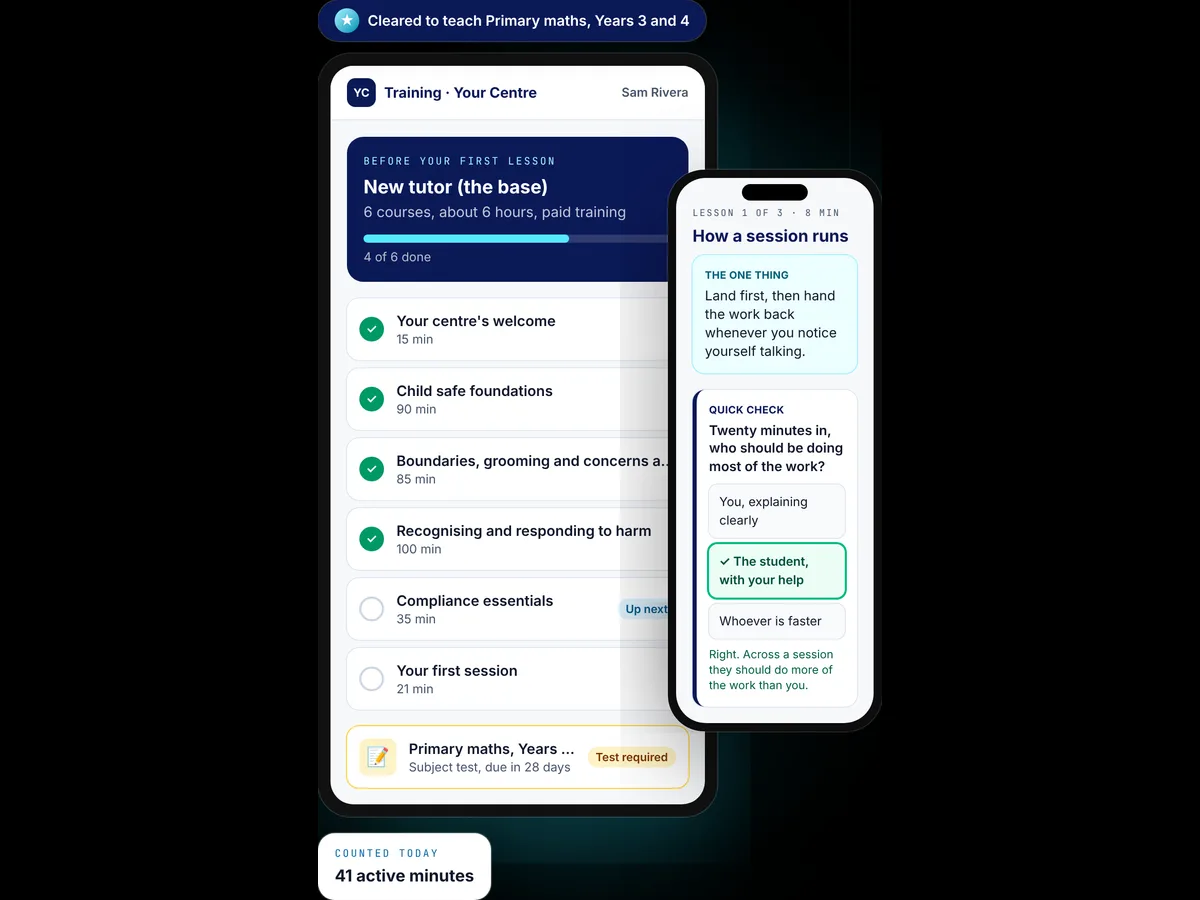
XTutio's training academy gives a new tutor a recommended base of about six hours before their first lesson, and subject tests that clear them for a subject at a year level. You can schedule an induction or a shadowing session in the portal, and send an applicant a one-time subject test before you hire. Staff never see a right answer, because the same questions clear your own tutors.
Questions centres ask
- Can a new tutor start before their Working with Children Check is cleared in NSW?
- Under the NSW legislation a person can start once they have an application number, which your centre must verify online. Some employers require a full clearance before work starts, and many tutoring centres choose to wait for it.
- What records do I need to keep about a tutor's check?
- The Office of the Children's Guardian lists the worker's full name, date of birth, check number, the verification date and outcome, the expiry date, and whether the work is paid or volunteer.
- How long should a new tutor shadow before teaching alone?
- Two or three sessions is a sensible minimum: one watching, then one or two teaching part of the lesson while observed. Extend it for a subject or year level they have not taught before.
Sources
- Role of an employer with the Working with Children Check, NSW Office of the Children's Guardian. Read 2026-10-17.
- Who needs a Check, NSW Office of the Children's Guardian. Read 2026-10-17.
- Apply for a WWCC, NSW Office of the Children's Guardian. Read 2026-10-17.
- What are the Child Safe Standards, NSW Office of the Children's Guardian. Read 2026-10-17.
- eLearning, NSW Office of the Children's Guardian. Read 2026-10-17.
