6 min read · Updated 2026-10-18
In short
Under NSW work health and safety law, a tutoring business that sends tutors alone into family homes must manage the risks of remote or isolated work, including a way for the tutor to get help. SafeWork NSW lists working in other people's homes as isolated work and suggests controls such as checking in and out, regular contact and duress alarms. Written home visit rules that families agree to protect both the tutor and the child.
General information, not legal advice. Laws and the regulators' rules change: check the sources below, and talk to your own adviser about your centre.
It is 7.40 pm and your tutor's Year 9 lesson in a family's home ended at 7.30. Nobody has heard from them. Is that a lesson running over, a flat phone, or something wrong? Most centres find out by texting the tutor's personal number and hoping. Home tutoring is popular with families and simple to sell, but it puts one adult alone in a house that the centre has never seen. Two duties meet there: the centre's duty to its tutor as a worker, and its duty to the child being taught. This checklist covers the first in detail and the second where they overlap. It is written for NSW; other states have their own work health and safety regulators.
What the law asks of the business
In WHS law the tutoring business is a person conducting a business or undertaking (PCBU). SafeWork NSW describes remote or isolated work as work where someone cannot get immediate help because of where, when or how it is done, and it names working alone and working in other people's homes as examples. That is exactly a home tutoring lesson.
SafeWork NSW says the PCBU must eliminate the risks or, where it cannot, minimise them so far as is reasonably practicable. That includes consulting the workers who do the visits, providing a system of work with effective communication, and having an emergency plan that covers people working away from the workplace. It points to clause 48 and sections 55A to 55D of the Work Health and Safety Regulation 2025, and treats isolated work as a psychosocial hazard as well as a physical one. If you are unsure how the duty applies to your arrangements, for example to tutors engaged as contractors, check with your adviser or SafeWork NSW.
Tutors have duties too: to take reasonable care for their own safety, follow reasonable instructions and report hazards and incidents.
Before the first visit
- Confirm the tutor holds a current Working with Children Check that you have verified online. See Working with Children Checks for NSW tutoring centres.
- Ask the family the practical questions: who will be home, how to get in, parking, pets and anything the tutor should know. Keep these notes apart from the general file.
- Agree in writing that an adult will be home for the whole lesson and that the lesson happens in a shared, open area of the house.
- Set the hours home lessons may run, and refuse bookings outside them.
- Have the family accept a short code of conduct covering photos, transport, gifts and contact between lessons.
- Do a simple risk assessment with the tutor. SafeWork NSW publishes a home safety risk assessment and a home safety checklist you can adapt.
On the day
- The tutor checks in on arrival and checks out when they leave, to someone at the centre who is watching.
- Someone is responsible for noticing a missing check-out and following up within a set number of minutes, then escalating to a named safety contact.
- The tutor has a way to call for help that is quick and discreet, and knows that using it will never be questioned.
- The tutor knows they may refuse to start, or leave early, if no adult is home or something feels wrong, and how that lesson will be charged.
- If the tutor is running late or is on their way, the family is told through centre channels, not the tutor's personal number.
Before the first visit
Working with Children Check verified, practical questions asked, an adult home and an open area agreed in writing, code of conduct accepted.
On the way
The family is told the tutor is on the way or running late through centre channels, never a personal number.
Arrival
The tutor checks in to someone at the centre who is watching.
During
A quick, discreet way to call for help, and permission to stop if no adult is home or something feels wrong.
Leaving
The tutor checks out. A missing check-out is followed up within set minutes, then escalated.
The same day
Any incident, near miss or concern is recorded.
Keeping addresses and notes to the people who need them
A family's address, gate code and notes about who is home are among the most sensitive things a tutoring centre holds. Share them with the tutor who is teaching that lesson, around the time of the visit, and not with every tutor or in group emails. Do not paste them into AI tools or spreadsheets that circulate. Our article on privacy for tutoring centres explains the wider rules.
After the visit and over time
- Record any incident, near miss or concern the same day, and review them monthly with the tutors who do home visits.
- Ask tutors what worries them. SafeWork NSW expects consultation, and tutors notice things first.
- Review your home visit rules each year, and ask families to accept them again when the part that affects them changes.
- Train tutors in reading a situation before they go in, in your emergency plan, and in how to respond if a child tells them something worrying.
A centre that teaches in homes should also know its child safety process. Our guide to the online classroom and home tutoring shows how to set it up in XTutio.
How XTutio helps
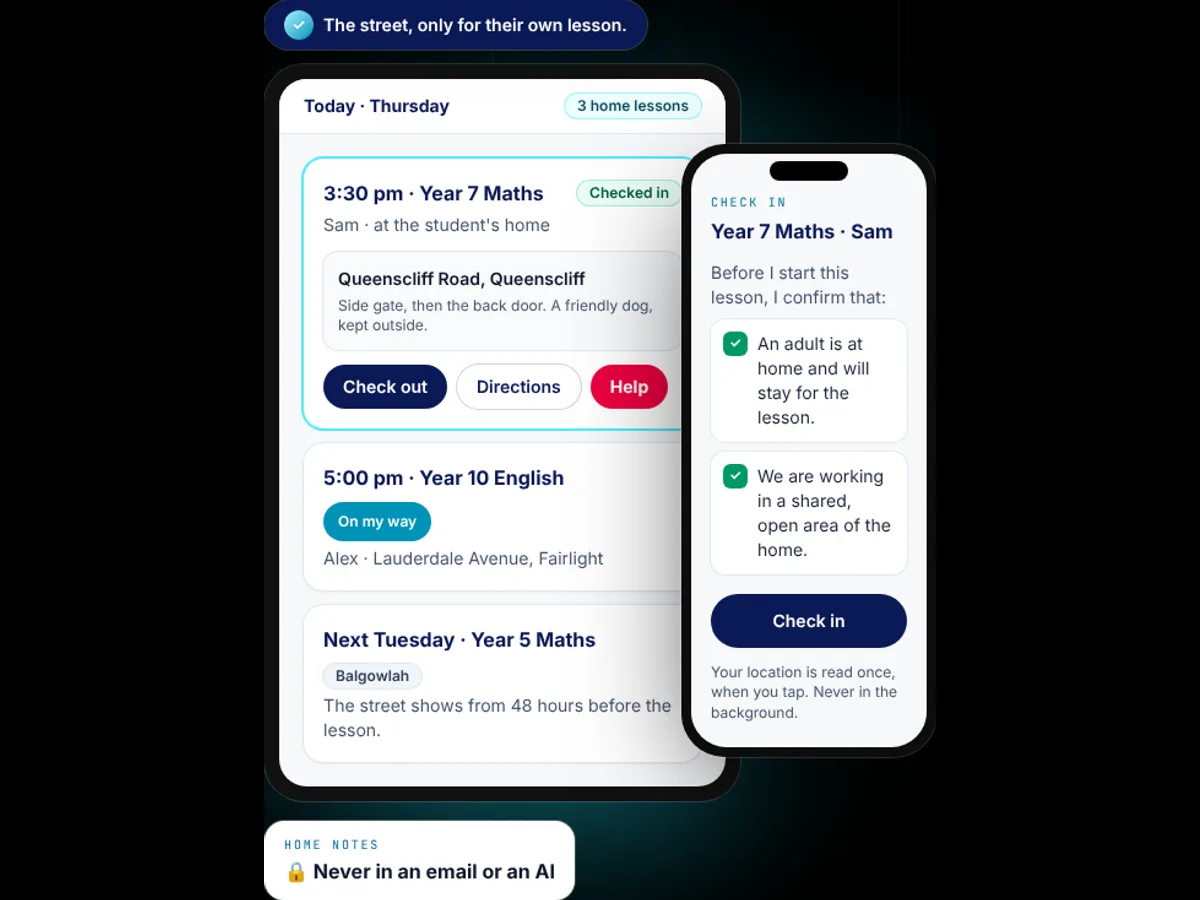
The 7.40 pm question has an answer in XTutio's home tutoring. The tutor taps Check in when they arrive, ticking your centre's own statements such as an adult being home, and Check out when they leave. With the check-in and check-out rule switched on, as it is in the starting templates, a timer follows up: if the tutor has not checked out a little after the lesson should have ended, they are asked if they are all right; no answer, and your safety contacts are alerted once. If they have not checked in 15 minutes after the start, they are asked, and 15 minutes later your safety contacts are told. The family is never alerted by the timer.
The help button is never refused. One tap emails and texts every safety contact with the address and the tutor's last location, and the screen says "Sent." only when someone was reached; otherwise it tells the tutor to call 000 or the centre. A location is read only when the tutor taps, never in the background. Your rules start from templates you change, families accept your code of conduct on their own page, and a tutor sees a family's street only around their own lesson. The detail of the day and of address sharing is in home visit check-ins and address privacy.
Questions centres ask
- Is home tutoring considered isolated work in NSW?
- Yes. SafeWork NSW lists working alone and working in other people's homes as examples of remote or isolated work, which the business must manage under WHS law.
- Does a tutoring business have to provide a way for home tutors to get help?
- SafeWork NSW says the business must provide a system of work with effective communication for isolated workers and an emergency plan that covers them. How you do it, such as a check-in system or a duress alarm, is yours to choose in consultation with your tutors.
- Should a parent be home during a home tutoring lesson?
- Most centres make an adult being home for the whole lesson a written rule that families agree to. It protects the child, the family and the tutor.
Sources
- Remote or isolated work, SafeWork NSW. Read 2026-10-18.
- Who needs a Check, NSW Office of the Children's Guardian. Read 2026-10-18.
