
5 min read · Updated 2026-10-18
In short
Most no-shows are forgotten lessons, so a reminder the day before and a policy families have actually read do most of the work. Make rebooking easier than cancelling, offer makeups inside a set window, and call a family after the second miss in a term, not the tenth. A late fee is the fallback, not the plan.
It is 4:05 pm, the tutor is sitting in an empty room, and the front desk is ringing a parent who does not pick up. At 4:20 a text arrives: sorry, we forgot. Every centre owner knows this afternoon. The seat costs you twice, because the tutor is usually still paid and the child falls further behind, which is the very thing the family is paying you to stop. Fees alone rarely fix it. Centres with few no-shows make lessons easy to remember, easy to move and awkward to forget, and they talk to families before a habit sets in.
Why families miss lessons
- They forgot. A lesson at the same time every week becomes invisible, especially in the first week back after a holiday.
- Something clashed: a school excursion, sport, an exam, a sick sibling. They meant to tell you and the day got away from them.
- Cancelling felt easier than rebooking, so they let it go.
- The child does not want to come, and the parent has stopped pushing. This one is a retention problem dressed as a no-show.
Each cause has a different fix, so it pays to know which one you are looking at before you reach for a fee.
Reminders that land
A short message the day before, with the child's first name, the subject, the time and the campus or link, prevents most forgotten lessons. A second one an hour before catches the family who read the first and still lost track of the afternoon. Send a note at the start of each term too, confirming the regular day and time, because that is when routines break.
- Keep reminders purely factual, with no offers in them, so they stay operational messages; see emailing and texting families.
- Say how to move the lesson in the same message, so a family who cannot come tells you now rather than not at all.
- Remind after any change of time, tutor or room, not only for the regular slot.
This is the job nobody at the front desk has time for, so it should not depend on them. In XTutio a centre can switch on lesson reminders: parents are emailed and texted 24 hours and an hour before each lesson, the student sees it in the app, and a lesson that was cancelled or moved after the reminder was queued sends nothing. If Teachworks still sends your reminders, leave the switch off until it stops, so families do not get two of everything.
A policy families have read
A cancellation policy only changes behaviour if families know it before they need it. Put it on the enrolment form with its own tick, link it from every invoice, and say it in one sentence at the first lesson: how much notice you need, what happens inside that window, and how makeups work. Keep the numbers few and plain. Our guide to writing a fair late cancellation policy covers notice periods, fees and the law.
Be consistent. A fee waived for one family and charged to another becomes the story parents tell each other at the school gate. Decide in advance what counts as an exception and apply it to everyone. XTutio helps here because there is only one source for the numbers: your centre's policy page is written from the same settings the cancellation charge uses, so the page and the bill can never disagree.
Make rebooking the easy path
When a family has to cancel, the best outcome for everyone is a makeup inside a week or two. Offer one before you mention any fee, against your tutors' real free times, and make it a couple of taps or one phone call. Set a window for makeups so they do not pile up at the end of term, and keep it short enough that the child does not fall behind.
- Offer a makeup
Two or three real times straight away, before any talk of fees.
- Show the figure
If none suits, tell the family exactly what your policy charges before they confirm.
- Hold the fee
Keep a late fee on hold for a few days instead of charging it at once.
- Waive it on attendance
If the child attends a makeup inside the hold, the fee is never charged.
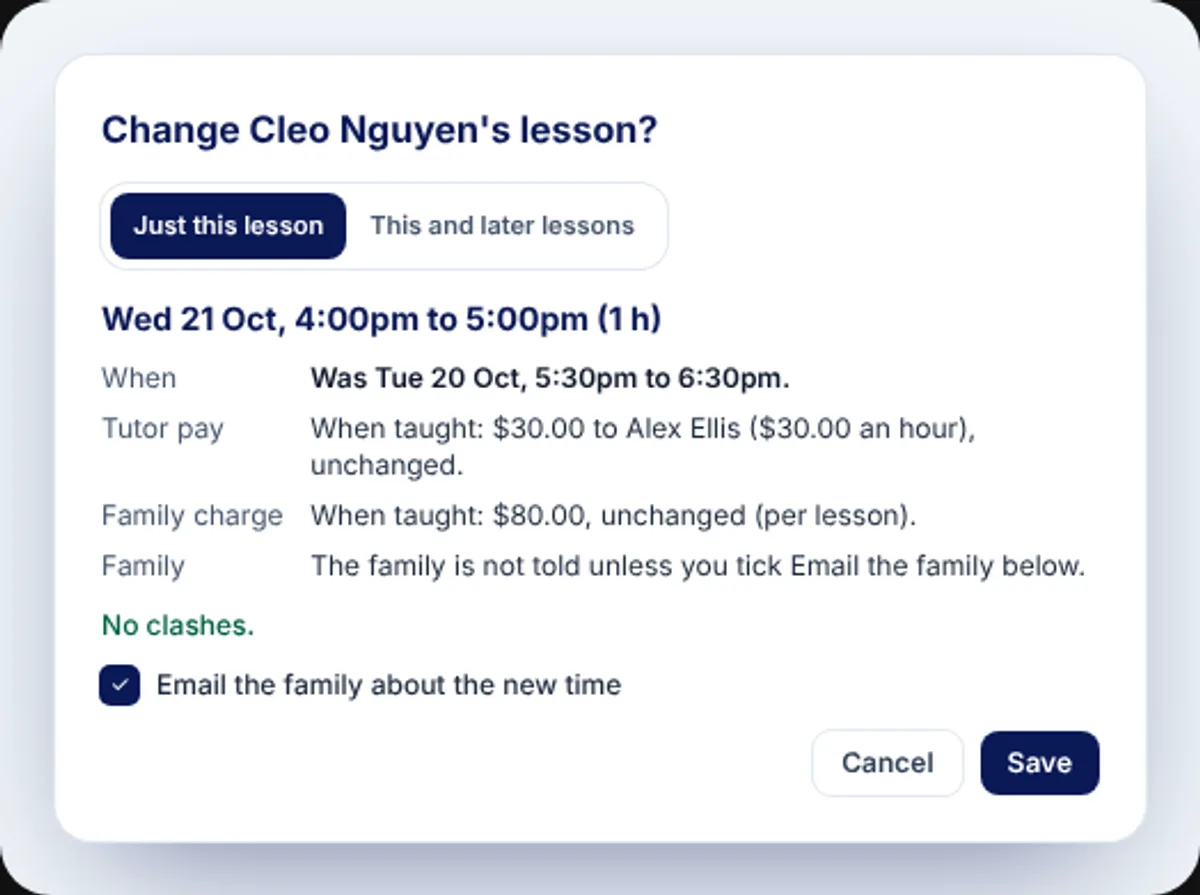
In XTutio, a parent cancelling from the portal sees rebooking as the first choice and the exact cost under your policy before they confirm. When a parent rings instead, reception records the cancellation as the family's and the screen shows the figure to read out. A held late fee is waived automatically if the makeup is attended, and when the tutor or the centre cancels, the family pays nothing and is owed a makeup. When staff move a lesson on the calendar, a change card checks clashes and the family is emailed about the new time only if someone ticks the box. See scheduling.
Track patterns, then talk
Keep a simple count of misses and late cancellations per student each term. Most families never appear on it. The few who do fall into two groups: a busy family that needs a different time, and a child who is drifting away. Both are worth a phone call after the second miss in a term, not a fee after the fifth.
- Ask whether the time still works. A move to another day often ends the problem.
- Ask how the child feels about the lessons. A change of tutor, goal or format may win them back.
- Agree what happens next and write it in the family's record so the next person at the desk knows.
A no-show checklist
- Reminders sent the day before and an hour before every lesson, and after every change
- Start-of-term message confirming each family's regular slot
- Cancellation policy ticked on the enrolment form and linked from invoices
- Makeups offered before any fee, inside a set window
- Late fees held, and waived when the makeup is attended
- Exceptions decided in advance and applied to every family
- Misses counted per student each term
- A call to the family after the second miss in a term
Setting up the bands, the hold and the makeup window takes a few minutes in XTutio; the guide to cancellations and late fees walks through each setting.
Questions centres ask
- How do tutoring centres reduce no-shows?
- Send a reminder the day before every lesson, make sure families have read the cancellation policy, and offer a makeup before any fee. Then call families after a second miss in a term to find out what is really going on.
- Should a tutoring centre charge for no-shows?
- Many do, but a fee works best as the fallback after reminders and easy rebooking. Whatever you charge, put it in your written policy, show it to families before they enrol and apply it consistently.
- When should I talk to a family about missed lessons?
- After the second miss or late cancellation in a term. Early on it is usually a timetable problem that a new slot can fix; later it is often a child who has lost interest.
